
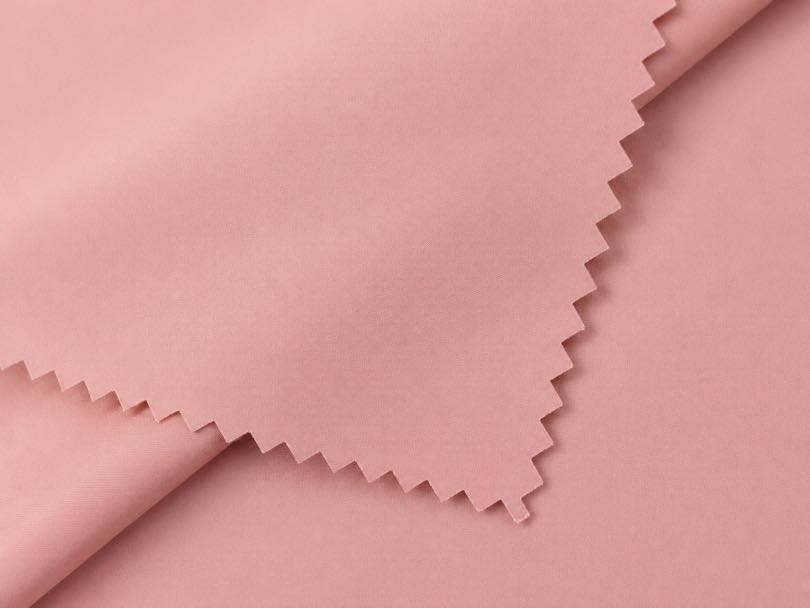
A pongee fabric specification that looks right on paper may still cause problems later. The jacket repels water in the showroom but starts to soak through after just a few washes. Or the bulk fabric feels nothing like the swatch. This guide will help you avoid these issues.
As a fabric manufacturer, we support our advice with two third-party test reports from our own fabrics, along with practical experience from our production process. By the end, you will know what water-repellency data does and does not prove, why bulk can differ from the sample, how to choose T count by end use, and how to brief a supplier.
What Is Pongee Fabric?
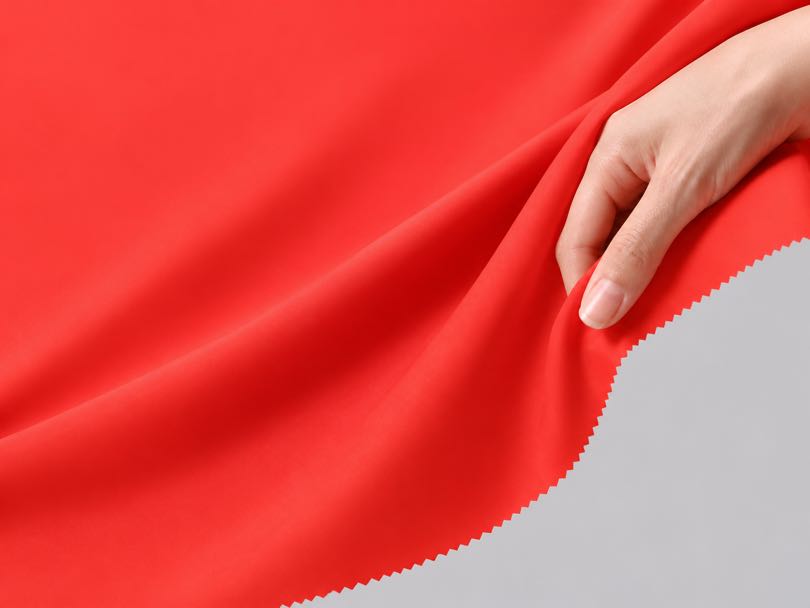
Pongee is a lightweight, plain-weave fabric with a smooth, lightly crisp hand. It began as a Chinese silk cloth, but most pongee in jackets, linings and umbrellas today is a polyester fabric that is light, quick-drying and easy to dye. It is commonly offered in semi-dull or full-dull (matte) luster.
That low weight is why pongee appears in outdoor and sports garments, and why it also serves as a base cloth for coating and lamination. Two pongee fabrics can behave very differently depending on yarn, density and finish, so choosing the right specifications is important.
First, though, let’s look at the question buyers ask most.
Is Pongee Fabric Waterproof? What the Lab Data Shows
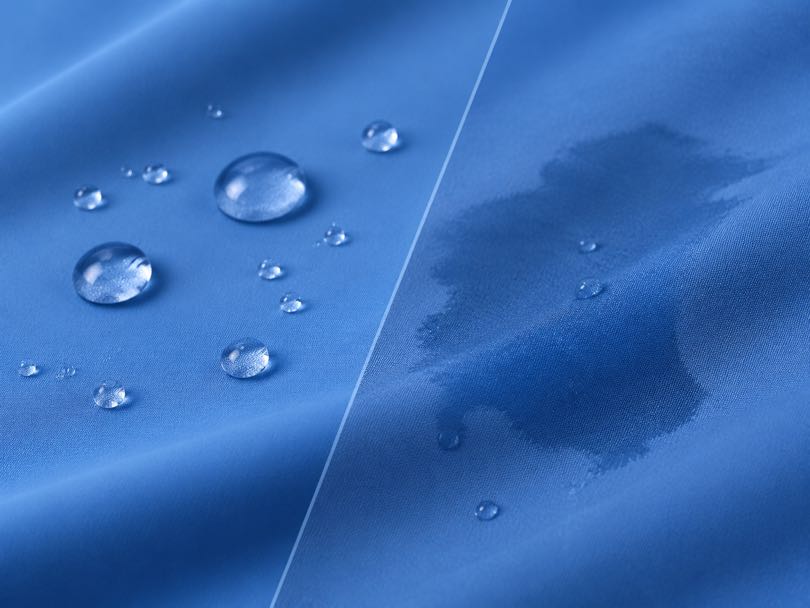
Not by itself. Most pongee fabrics are water repellent, meaning a durable water repellent (DWR) finish helps water drops form beads and roll off the surface. Truly waterproof fabric usually needs a PU coating or TPU film and is tested for water pressure using hydrostatic head (mm H₂O).
Mixing these up is the most common misunderstanding we meet. A buyer sees water drops roll off a sample and assumes the fabric can handle heavy rain. But under continuous rain, water may still pass through the fabric.
The standard repellency check is the spray test. AATCC TM22 measures how well a fabric resists wetting by water, so it reflects surface wetting, not water pressure. Here is how one of our pongee fabrics performed.
Data card 1: spray rating before and after washing
Item | Details |
Sample | Coffee-colored woven pongee, submitted as "300 pongee" |
Method | AATCC TM22-2024 spray test, water at 27 °C |
Washing | 10 cycles, AATCC TM135-2025, Normal cycle, 27 ± 3 °C, 1993 AATCC standard reference detergent, tumble dry normal |
Result before washing | 95 / 95 / 95 (three specimens) |
Result after 10 washes | 95 / 95 / 95 (three specimens) |
Report | No. ZFLJ01177902, United Testing Services (Jiangsu) Co., Ltd., 30 Oct 2026 |
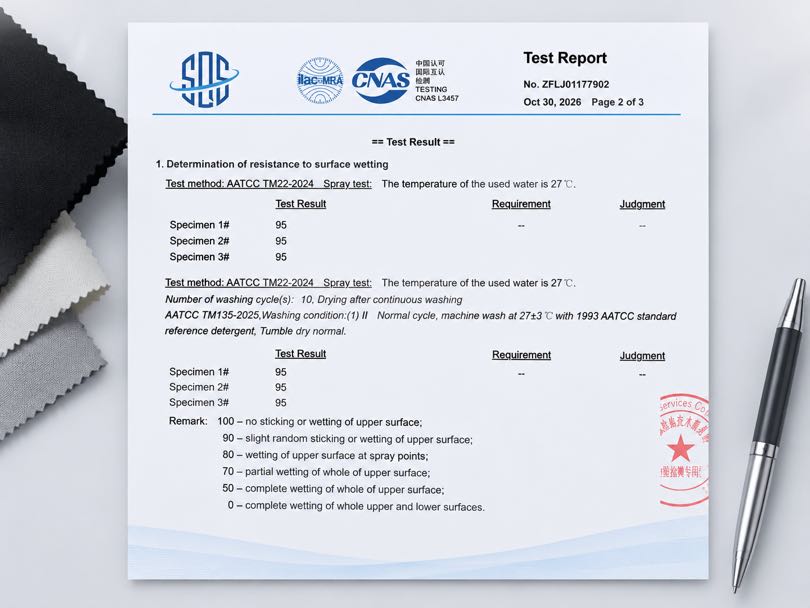
On the AATCC scale, 100 means no sticking or wetting of the upper surface and 90 means slight wetting in a few areas, so 95 sits between the two. What stands out is that all three specimens scored the same before and after 10 wash cycles.
Note: The report sets no pass/fail criterion, so we read it as measured performance rather than proof that the fabric meets a buyer’s specific requirements. It also covers only one fabric, one color and one washing method, so it shows what this particular finish can achieve, not what every pongee will do. The next section explains why.
What We See in Production
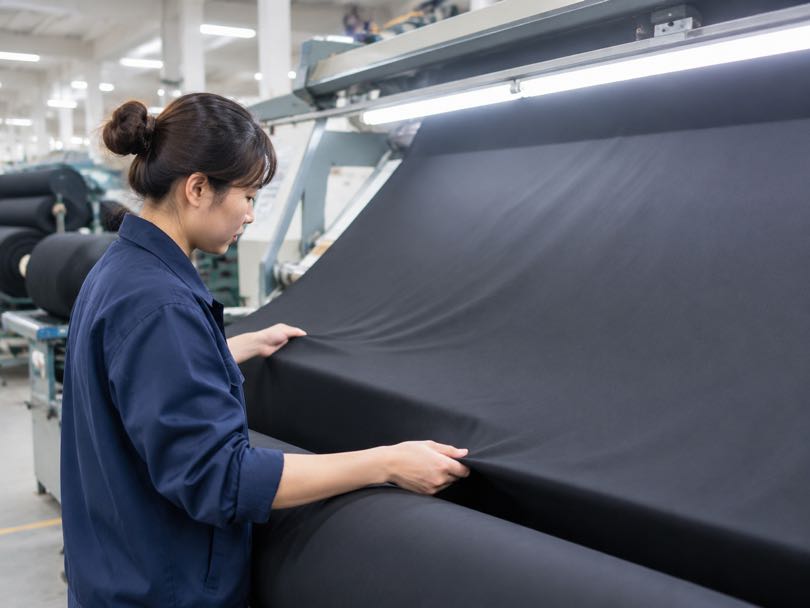
A good lab result is only part of the story. Here are some common issues we see during fabric production.
Why water repellency fades
DWR is a finish that can wear off over time, so some fading is normal, but the speed depends on use. The usual causes are abrasion at cuffs, hems and backpack straps, oils from skin and lotions, detergent or softener residue, high-heat drying or ironing, and repeated washing.
End users can slow it by using a neutral detergent made for technical fabrics, avoiding fabric softener and bleach, drying at a low temperature and cleaning oil stains promptly. When water no longer forms beads on the surface, a spray-on or wash-in water-repellent treatment can help restore its performance.
Why Colors and Production Batches Perform Differently
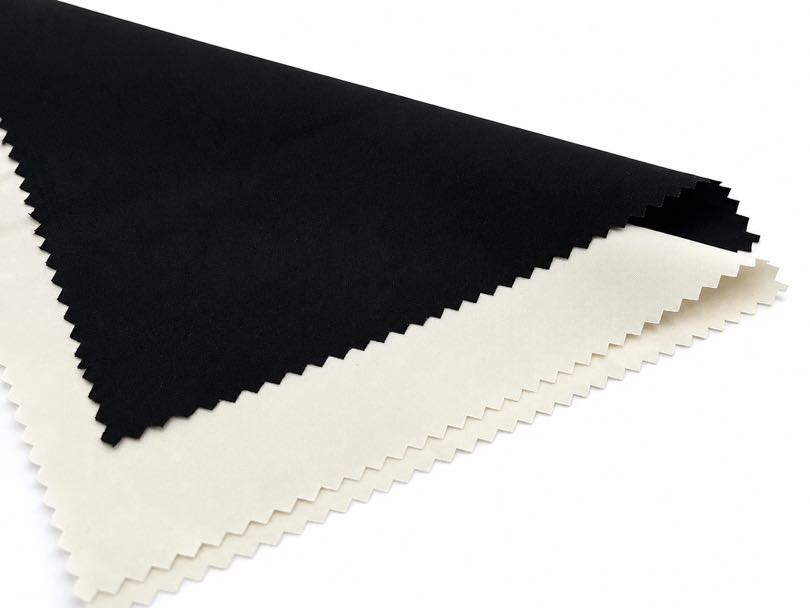
The same finish may not work equally well on every color. In our experience, dark shades use more dyes and processing chemicals, which may leave residue on the fabric surface and affect how evenly the water-repellent finish is applied. Light shades generally have less of this issue.
Differences between batches usually come from several factors, including how well the greige fabric is cleaned before dyeing, the pH level after dyeing, heat-setting temperature, production speed and the quality of the water-repellent agent used. Even leftover oil on the fabric can lower the test rating by one grade.
Why Bulk Fabric Can Differ from the Sample
Sample approved, bulk rejected is a familiar story. Small sample dye lots are easier to control than large dye machines, and samples often get a dedicated heat-setting run while bulk runs faster with less stable temperature. Samples may be carefully selected, while bulk fabric may vary in yarn tension and density across different warp beams.
How to Choose T Count and Yarn by End Use
T count is the total number of warp and weft threads per inch. A higher number means a tighter fabric, which helps with wind resistance and, once finished or coated, water resistance, but it does not guarantee performance on its own.
Many buyers discover this when two fabrics labeled “210T” feel different. Yarn denier also affects the fabric’s feel and performance, and the two specifications work together:
T count | Yarn (warp × weft) | Typical use |
190T, 210T, 230T, 240T, 260T, 280T | 75D × 75D | Linings, sportswear, coated jackets |
300T, 320T, 350T | 50D × 50D | Down jackets |
380T, 400T, 420T | 30D × 30D | Down jackets |
Use this table as a guide. The 190T–280T range uses thicker yarn and suits lining fabric, sportswear and coated jackets. From 300T upward, finer yarns (50D, then 30D) create a denser, smoother and softer fabric for down jackets. Finer yarns and higher density usually cost more and require better process control, so choose specs based on actual needs.
T count measures the number of threads, not their thickness. Yarn tension, heat setting and softener use also affect how the fabric feels. When preparing a fabric spec, include yarn denier, weave, gsm, width, luster (semi-dull or full-dull), finishing methods such as calendering, coating type, and your target hydrostatic head and spray rating.
Fluorine-Free DWR and PFAS Testing
Water-repellent chemicals are receiving more attention in Europe. ECHA’s scientific committees have supported an EU-wide PFAS restriction with some specific exemptions, and the process is still moving toward a final decision.
Many buyers now request fluorine-free finishes that meet REACH and ZDHC requirements while maintaining good water repellency after washing. However, fluorine-free DWR is generally less durable than C6 finishes after the same number of washes and more sensitive to fabric cleanliness and setting temperature.
If you need a fluorine-free finish, specify it early and request wash-test results for that version, not a C6 version. For chemical safety certification, see our guide to OEKO-TEX certified fabric.
Our second report covers a different fabric and a different question: PFAS screening.
Data card 2: PFAS screening
Item | Details |
Sample | Chocolate 350T poly pongee |
Method | EN 17681-1:2025 |
Scope | 60 target PFAS substances |
Result | Not detected (N.D.) for all 60 |
Detection limits | Mostly 10 μg/kg; 100 μg/kg or 1.0 μg/m² for some substances |
Report | No. SH-WS 2025-016955, Jiangsu New Horizon Testing, Inspection and Certification Co., Ltd., 14 Nov 2025 |
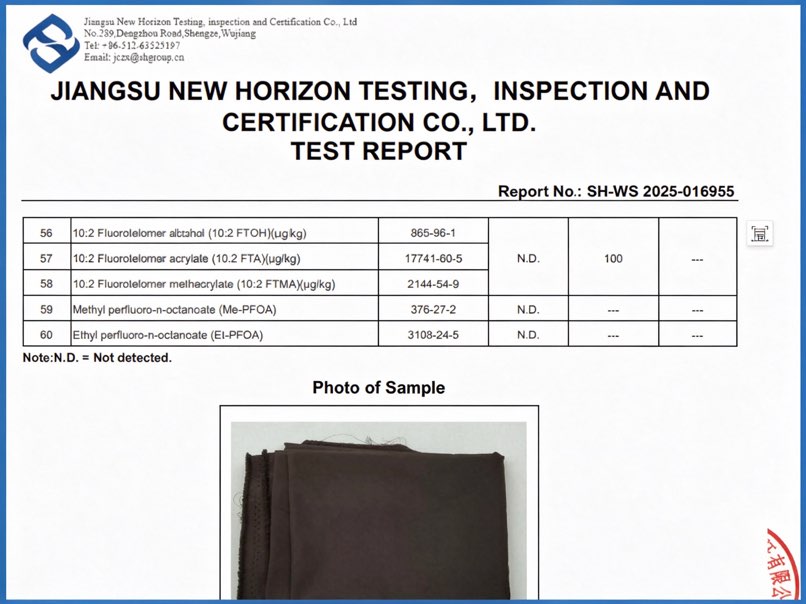
None of the 60 listed substances was detected above the test limits. However, this does not confirm the absence of all PFAS, it does not say which repellent was used, and it does not measure water repellency.
Note: Because the two reports cover different fabrics, we present them separately. When any supplier claims “PFAS-free”, ask for the method, the substance list and the detection limits.
Pongee as a Base Fabric for Lamination
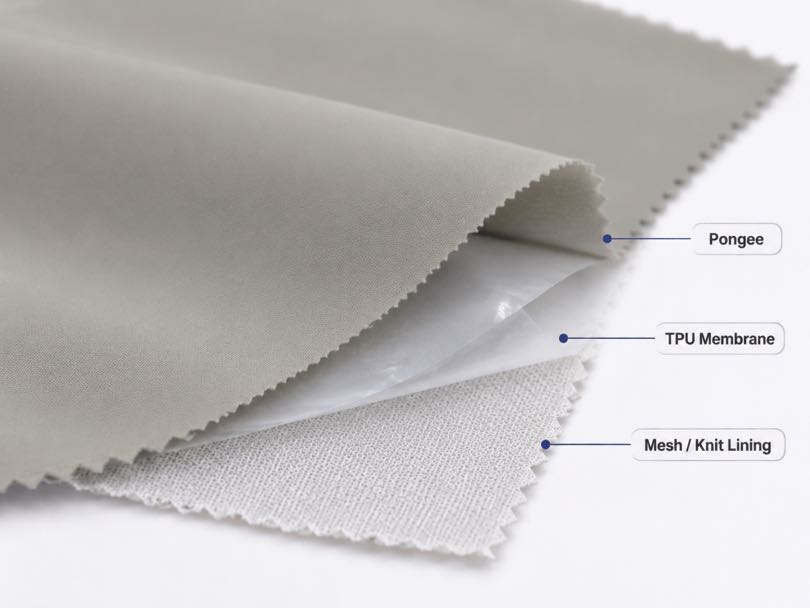
If you plan to bond pongee to a film or membrane, the base cloth matters more than most buyers expect. Look for low shrinkage, a clean surface with little oil or loose fiber, controlled softener use, even density and enough heat stability for the bonding temperature.
A pongee that works well as a lining may not be suitable for laminated fabric. Uneven shrinkage can cause bubbles or layers to separate. Softener or cleaning agent residue can also affect the glue and cause peeling after washing. A very dark base fabric may show through a light film, while prints applied before lamination may bleed when exposed to heat.
Heat-set the base cloth separately and test shrinkage before bonding. Keep softener to a minimum, and send base cloth to your laminator for a wetting test at the sampling stage. Where you can, laminate first and print afterward.
How to Evaluate and Request Pongee Samples
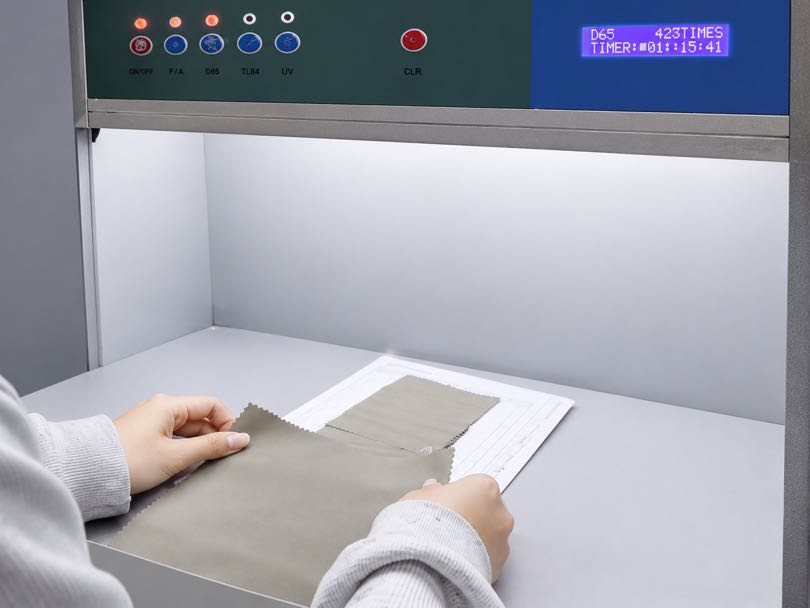
You do not need a lab for an initial check. Check the sample in daylight or under a D65 light for oil spots, color points, hairiness and shade difference between selvedge and center.
Compare the feel with the approved sample, then gently stretch the fabric in both directions to see how well it returns to shape. Next, rub the fabric several times and drop some water on its surface. If water stops forming beads quickly, the finish may not last long.
When asking for a quote, be specific about what you need. Simply saying “I need 210T pongee” is not enough. The supplier also needs to know whether you want a fluorine-free water-repellent finish and whether the fabric needs to withstand 5,000 mm of water pressure for a rain jacket. To avoid confusion, include the following details:
- End product and intended use
- T count, yarn denier, gsm, width and luster
- Finish type (DWR, PU or TPU), fluorine-free or not, and hydrostatic head target
- Wash count and the spray rating you expect after washing
- Color reference, colorfastness standard, target price and lead time
Always ask for a sealed sample with written test conditions. For example, “spray rating 90 or above (AATCC TM22) after 5 washes” cannot be confirmed with an unwashed sample. Keep a sample from the same production lot and record its dyeing and finishing details. Use it to compare with the bulk fabric.
Conclusion
Choosing pongee comes down to three checks: a spec that goes beyond T count, repellency data with clear test conditions, and a supplier who can hold the sample’s performance in bulk. Start by defining your end use and water-pressure requirements, then ask for a sealed sample with spray-test results before and after washing.
Talk to Our Fabric Team
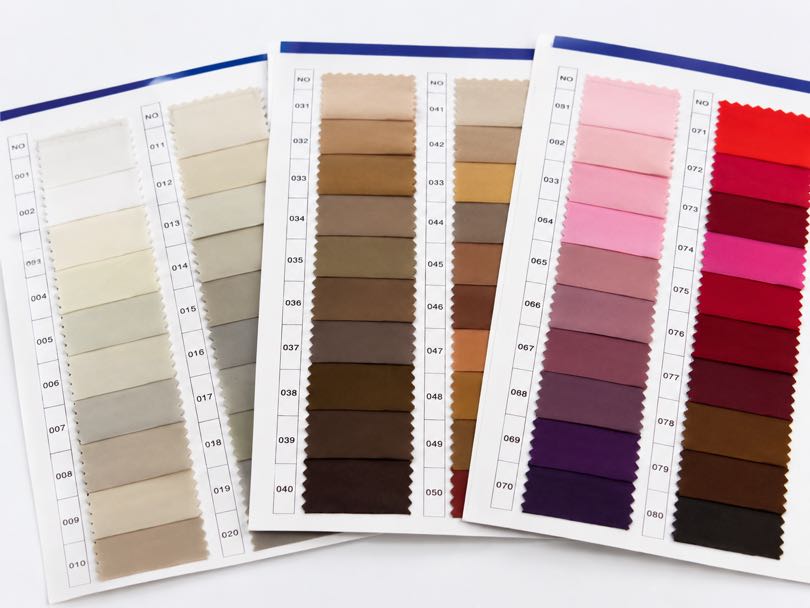
Finding the right pongee is just the first step. The next is making sure it meets your requirements in both sampling and bulk production. At Idear Textile, we supply pongee and other functional fabrics for jackets, outdoor clothing and sportswear. Explore our pongee fabric range or contact our team with your fabric requirements. We can help you choose a suitable construction and arrange samples for testing.
FAQ
What does T count mean in pongee fabric?
It is the total number of warp and weft threads per inch. It shows how dense the cloth is, but yarn denier and finishing also shape the result.
Is pongee fabric waterproof?
Not by itself. A DWR finish makes it water repellent, while waterproof performance needs a PU coating or TPU film with a hydrostatic head rating.
Which T count is best for down jackets?
The usual choices are 300T–350T with 50D × 50D yarn, or 380T–420T with 30D × 30D yarn. Linings, sportswear and coated jackets more often use 190T–280T with 75D × 75D yarn.
How can I keep a water-repellent finish working longer?
Use a neutral detergent, avoid softener and high heat, and clean oil stains promptly. Reproof once water stops beading.