
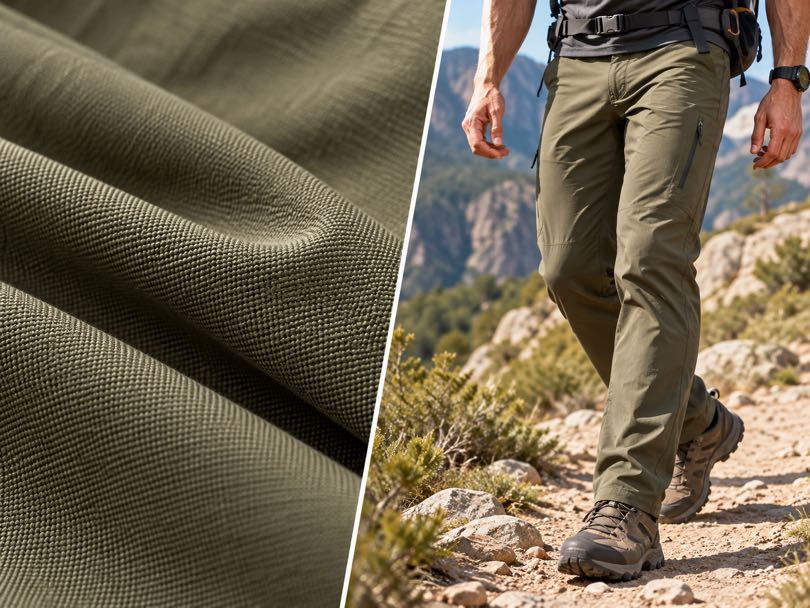
Choosing the right 4 way stretch fabric involves more than checking its stretch percentage. A fabric may stretch easily during sampling but lose its shape after repeated movement or washing. Similarly, waterproof coatings or lamination can affect the elasticity of the finished fabric.
In this guide, we’ll explain how 4-way stretch fabrics work, compare common fabric types, and share application-based selection recommendations. We’ll also share our own real third-party test results to help you evaluate stretch performance before bulk production.
What Is 4 Way Stretch Fabric?
4 way stretch fabric is a textile that stretches in both the lengthwise and widthwise directions, allowing greater freedom of movement and improved comfort. Unlike conventional non-stretch materials, it supports body movements such as bending, squatting, reaching, and twisting.
4 way stretch fabrics are commonly made from polyester or nylon combined with spandex (elastane). However, some fabrics achieve multidirectional flexibility through yarn engineering and textile construction without relying entirely on spandex.
These materials are widely used in:
- Outdoor jackets and hiking pants
- Sportswear and activewear
- Softshell jackets
- Casual trousers and uniforms
- Fitted performance clothing
For fabric buyers, it’s important to understand that stretch and elastic recovery are not the same. A fabric must not only stretch but also return to its original shape to maintain a good fit.
How Does 4 Way Stretch Fabric Work?
Stretch Directions: Warp and Weft
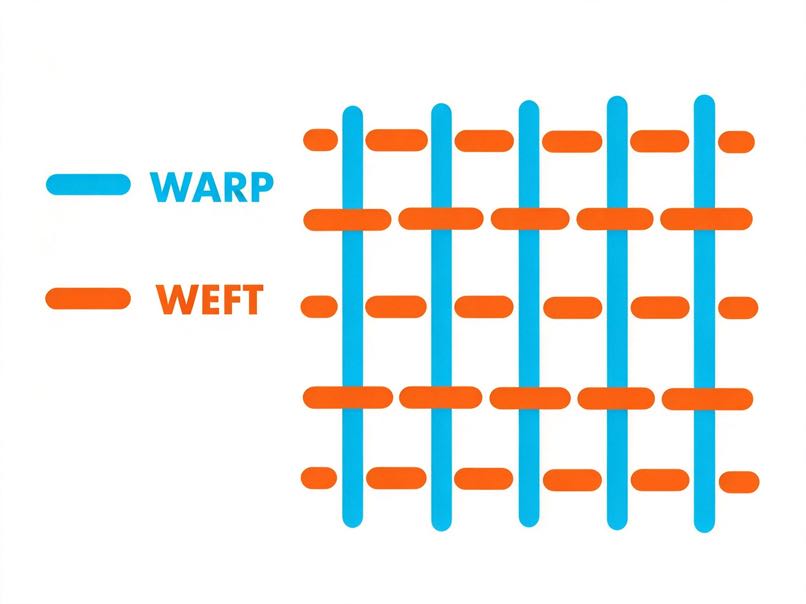
Woven fabrics have two primary directions: warp, which runs lengthwise and parallel to the fabric’s edge, and weft, which runs widthwise and perpendicular to the edge.
Knitted fabrics use connected loops, unlike woven fabrics that use warp and weft yarns. Their loop structure naturally provides flexibility, while elastane can improve stretch and recovery.
The Role of Spandex and Fabric Construction
Spandex fibers can stretch significantly and recover when tension is released. Blending spandex with polyester or nylon allows manufacturers to combine flexibility with the strength and other characteristics of the base fibers.
However, spandex content alone does not determine performance.
Yarn specifications, fabric density, weave or knit structure, heat setting, and finishing treatments all influence the final result.
Woven vs. Knitted 4 Way Stretch Fabrics
Woven stretch fabrics generally offer better dimensional structure and are often selected for outdoor pants, jackets, and workwear.
Knitted stretch fabrics typically provide greater flexibility and a softer, more body-hugging feel, making them suitable for leggings, training tops, and fitted sportswear.
For outdoor and functional apparel that requires durability, shape retention, and weather protection, woven 4-way stretch fabrics are often a practical choice.
2 Way vs. 4 Way Stretch Fabric: What’s the Difference?
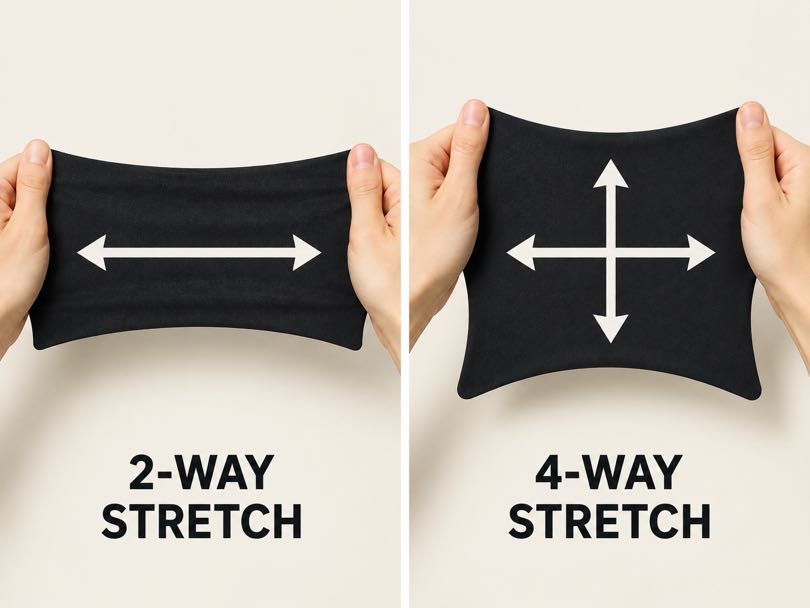
Both materials improve comfort compared with rigid fabrics, but their movement characteristics differ.
Feature | 2-Way Stretch Fabric | 4-Way Stretch Fabric |
Stretch Direction | Primarily one direction | Lengthwise and widthwise |
Movement | Direction-dependent | Multidirectional |
Common Construction | Stretch woven or knit | Stretch woven or knit |
Typical Applications | Casual pants, structured apparel | Hiking pants, sportswear, softshell |
Main Advantage | Targeted flexibility | Greater movement freedom |
Which One Should You Choose?
For structured trousers that mainly require flexibility around the waist and hips, 2-way stretch may be sufficient.
For hiking pants, fitted sportswear, or jackets requiring multidirectional movement, 4-way stretch often provides greater design flexibility.
However, more stretch is not automatically better. Excessive extension without adequate recovery can cause garments to lose their shape, especially around the knees and elbows.
Common Types of 4 Way Stretch Fabrics
Four-way stretch materials can be classified by fiber composition, textile construction, and stretch technology. These categories may overlap.
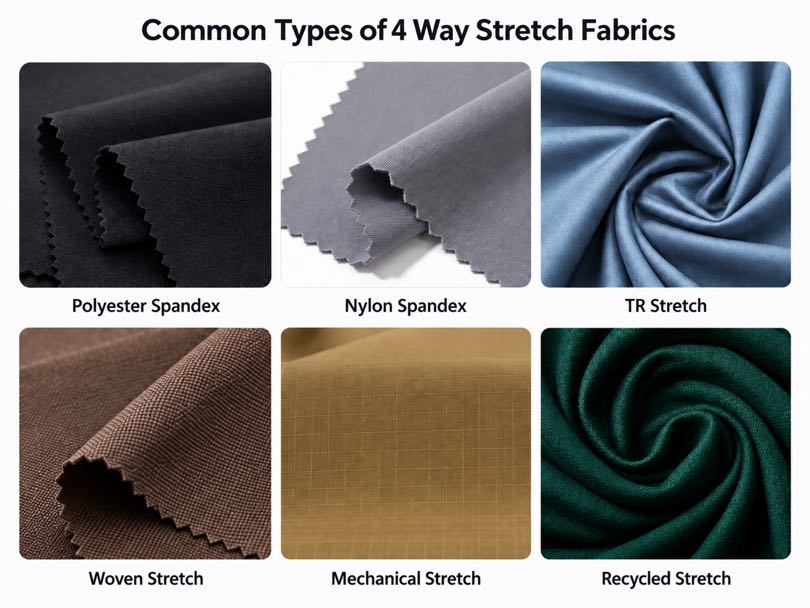
Polyester Spandex 4 Way Stretch Fabric
Polyester-spandex fabrics offer a practical balance of flexibility, dimensional stability, and cost. They are commonly used in sportswear, casual jackets, and lightweight outdoor apparel. Polyester can also be engineered with moisture-management finishes or specialized yarn structures.
Nylon Spandex 4 Way Stretch Fabric
Nylon-spandex fabrics are popular in hiking trousers and performance apparel because nylon can provide good abrasion resistance and a comfortable hand feel. Actual durability depends on yarn size, fabric construction, and finishing rather than fiber composition alone.
Polyester Viscose Spandex 4 Way Stretch Fabric
Polyester viscose spandex fabrics, also known as TR stretch fabrics, combine a soft feel, good drape, and flexibility. They are commonly used in business trousers, suits, office uniforms, and casual wear. Their stretch performance and shape retention depend on the fabric construction and spandex content.
Woven 4 Way Stretch Fabric
Woven 4-way stretch fabrics combine structural stability with flexibility. They are particularly suitable for outdoor pants, work uniforms, and stretch jackets requiring reliable shape retention.
Knitted 4 Way Stretch Fabric
Knitted 4-way stretch fabrics provide flexibility and comfort for garments that closely follow body movement. Common applications include leggings, yoga clothing, cycling jerseys, and training apparel.
Mechanical 4 Way Stretch Fabric
Mechanical stretch fabrics achieve flexibility through engineered yarns or textile structures. Common examples include T400 fabric and T800 fabric, which offer stretch and recovery without relying on conventional spandex fibers.
They can be alternatives for applications where spandex content needs to be reduced, although stretch and recovery performance must be tested individually.
Recycled 4 Way Stretch Fabric
Recycled polyester or nylon can be combined with spandex to produce stretch fabrics for performance apparel. Buyers requesting certified recycled content should check the Global Recycled Standard (GRS) requirements and relevant supply-chain documents.
Key Properties and Benefits of 4 Way Stretch Fabric
Freedom of Movement
Multidirectional elasticity allows fabric to follow body movements more comfortably, making it useful for active garments.
Elastic Recovery and Shape Retention
Elastic recovery describes how effectively fabric returns toward its original dimensions after stretching. Poor recovery can cause fabric to lose its shape, especially around the knees or elbows.
Comfort and Fit
Stretch fabrics can reduce movement restrictions while supporting fitted garment designs. Comfort also depends on fabric weight, surface texture, breathability, and garment construction.
Durability and Functional Performance
Four-way stretch fabrics can be engineered for abrasion resistance, tear strength, moisture management, or weather protection.
However, these characteristics are not guaranteed by stretch performance alone. They require appropriate materials, construction, finishing, and testing.
What Is 4 Way Stretch Fabric Used For?
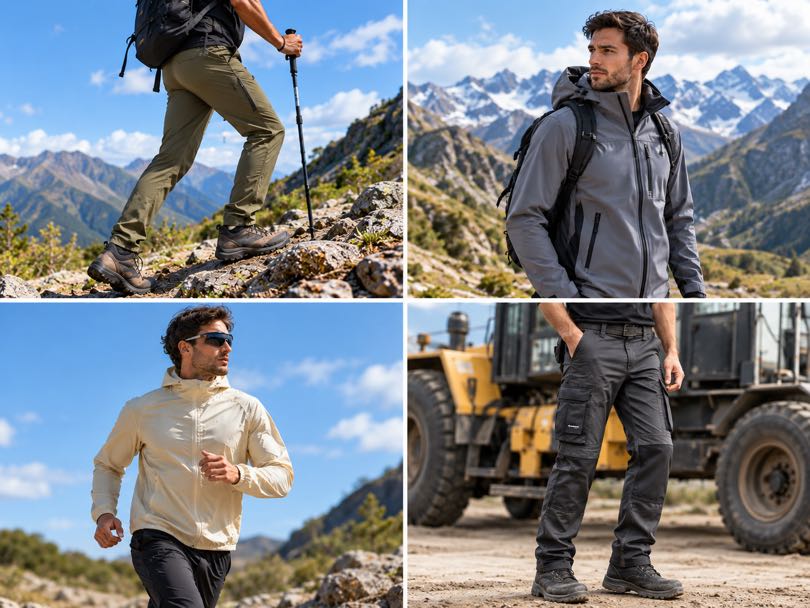
Different garments require different balances of stretch, weight, strength, and finishing. The following specifications are recommended ranges, not fixed industry standards.
Application | Fabric Selection | Recommended Fabric Specifications |
Hiking Pants | Nylon/Spandex Woven (86~92% Nylon +8~14% Spandex) | GSM:140–180 gsm 4-way elongation:Warp 20–30% / Weft 40–60% Elastic Recovery:≥92% (30min) Tear strength:≥25N warp / ≥20N weft Abrasion:≥20,000 cycles Martindale |
Outdoor Jackets | Polyester/Spandex Woven (90~94% Polyester +6~10% Spandex) | GSM:110–150 gsm 4-way elongation:Warp 15–25% / Weft 35–50% Elastic Recovery ≥90% Air permeability:80–150 L/m²/s |
Softshell Jackets | Stretch Woven + Fleece / Membrane Polyester stretch woven bonded with micro fleece / TPU membrane | GSM:260–340 gsm(3-layer bonded) 4-way elongation:Warp 20–30% / Weft 40–55% Elastic Recovery: ≥90% Hydrostatic pressure:5,000–10,000 mm RET:<13 m²·Pa/W (high breathability) |
Workwear | Durable Stretch Woven (93~96% Polyester +4~7% Spandex) | GSM:220–280 gsm 4-way elongation:Warp 15–20% / Weft 30–40% Elastic Recovery ≥93% Tear strength ≥30N warp / ≥25N weft Tensile strength ≥450N |
Sportswear | Polyester/Spandex Knit (88~92% Polyester +8~12% Spandex) | GSM:180–240 gsm 4-way elongation:Warp 40–60% / Weft 60–80% Elastic Recovery≥94% |
These recommendations are based on our bulk production experience with outdoor and sportswear fabrics. We help buyers turn garment requirements into clear fabric specifications and avoid misunderstandings during sampling.
Note: We can customize fabric specifications based on project needs, such as lighter GSM for hiking shorts or higher tear strength for durable workwear.
How to Test 4 Way Stretch Fabric
Stretch performance should be evaluated through measurable properties rather than hand feel alone.
Simple Two-Direction Stretch Test
A basic manual test involves marking a measured section of fabric and gently stretching it lengthwise and widthwise. This helps identify the main stretch directions, but it cannot replace standard laboratory testing.
Measuring Stretch Percentage
Stretch percentage can be expressed as:
Stretch (%) = [(Extended Length − Original Length) / Original Length] × 100
However, results depend on applied force, sample size, and testing conditions.
Importantly, elongation at break measures how much a fabric stretches before breaking. This is different from the recoverable stretch during normal wear.
Testing Elastic Recovery and Permanent Deformation
Elastic recovery measures how effectively a fabric returns after extension. Permanent deformation refers to the change in fabric shape that remains after recovery.
Note: International standard ISO 20932-1:2018 provides test methods for measuring fabric elasticity and related properties. Buyers should request results for both directions under consistent test conditions.
Real Fabric Test Results: Our Own Test Data
Our third-party test results for a stretch woven fabric show why buyers should evaluate several fabric performance indicators together.
Test Property | Warp | Weft |
Breaking Force | 620N | 370 N |
Elongation at Break | 60.5% | 56.5% |
Elastic Recovery | 93.4% | 87.4% |
Tear Strength | 25 N | 19 N |
The above test results were obtained using FZ/T 01034-2008 for elastic recovery (25 N fixed force, three cycles), GB/T 3923.1-2013 for breaking force and elongation at break, and GB/T 3917.2-2009 for tear strength.
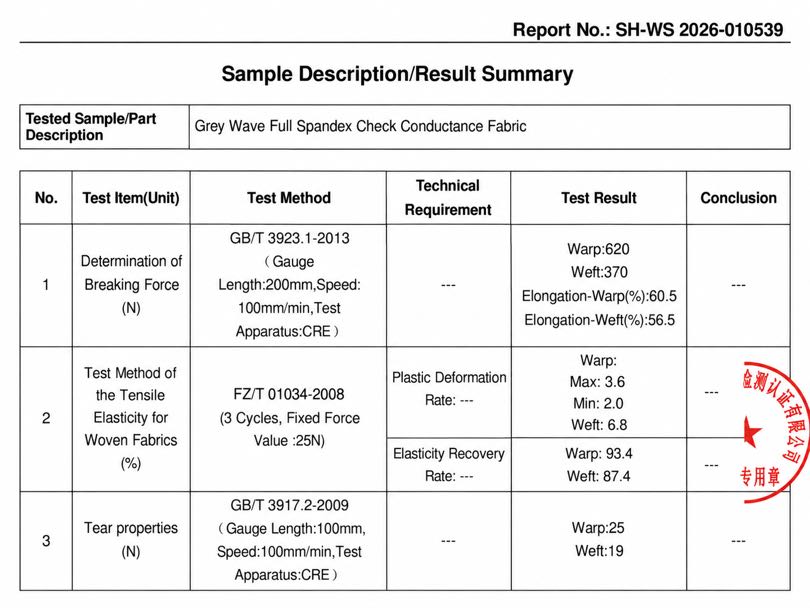
What do these results tell fabric buyers?
First, elastic recovery differs between the warp (93.4%) and weft (87.4%) directions.
Second, elongation at break and elastic recovery are different. A fabric that stretches well may not always return to its original shape.
Third, tear strength is also important, especially for outdoor and workwear fabrics.
Note: These results apply only to the tested sample and do not show performance after repeated washing or long-term use.
Why Finishing Processes Matter
A fabric’s properties can change during heat setting, coating, or lamination. For example, adding a membrane and adhesive may reduce flexibility, while excessive heat can affect spandex performance.
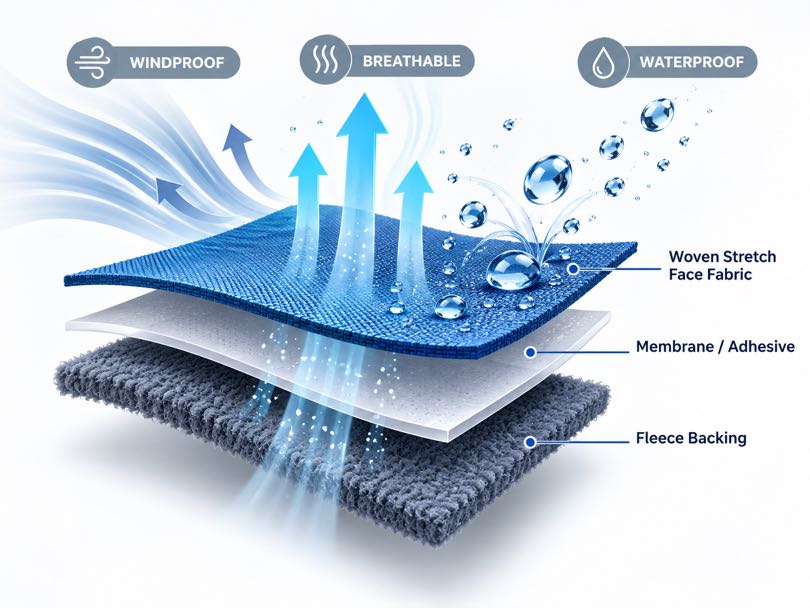
DWR treatment and waterproof coating are different processes. For example, the AATCC TM22 test measures surface water repellency. For stretch fabrics, always check whether test results apply to the base fabric or the finished product.
When comparing samples, buyers should use the same test methods and check the performance of the final finished fabric.
How to Choose the Right 4 Way Stretch Fabric
Start with the Garment Application
First, consider whether the garment needs flexibility, abrasion resistance, a good fit, moisture management, or weather protection.
Hiking pants and yoga leggings may both use 4-way stretch fabric, but their material requirements differ substantially.
Select the Fiber Composition and Construction
Choose nylon or polyester according to the required performance, cost, hand feel, and durability.
Then decide whether woven or knitted construction better suits the garment.
Check GSM, Recovery, and Strength
Avoid making purchasing decisions based only on fabric weight or spandex content.
Request stretch and recovery results, tear or tensile strength, and relevant dimensional-stability data.
Evaluate Functional Finishes
For outdoor applications, consider PFAS-free DWR, waterproof membranes, UV protection, or moisture-management finishes where appropriate.
Test the finished fabric to confirm that these processes do not compromise essential stretch performance.
Verify Bulk Production Consistency
Before approving bulk production, establish agreed specifications, testing methods, and acceptable tolerances. Compare laboratory samples, production samples, and bulk fabric against the same requirements.
This process helps reduce unexpected differences in elasticity, hand feel, dimensions, and functional performance.
Frequently Asked Questions About 4 Way Stretch Fabric
Is 4 Way Stretch Fabric Always Made with Spandex?
No. Spandex is common, but engineered yarns and fabric constructions can also produce multidirectional stretch.
Is 4 Way Stretch Fabric Breathable?
It depends on fiber composition, fabric density, construction, and finishing. Stretch alone does not determine breathability.
Does 4 Way Stretch Fabric Lose Its Elasticity?
Elastic performance can decline through repeated use, unsuitable washing, heat exposure, or material degradation. Proper construction and testing help evaluate these risks.
Is 4 Way Stretch Fabric Waterproof?
Not automatically. Waterproof performance typically requires an appropriate coating, membrane, or other suitable construction. DWR alone does not make a fabric fully waterproof.
Which Is Better: 2 Way or 4 Way Stretch Fabric?
Neither is universally better. Choose according to garment movement, fit, durability requirements, and production cost.
Conclusion
The best 4 way stretch fabric is not necessarily the one with the highest stretch percentage. For outdoor apparel, sportswear, softshell jackets, and workwear, successful fabric selection requires balancing flexibility, elastic recovery, strength, weight, and finishing performance.
Before placing bulk orders, establish measurable specifications and verify test results under relevant conditions. This approach helps fabric buyers make more informed material decisions and reduce development risks.
Need 4 Way Stretch Fabric for Your Next Project?
Every apparel project has different fabric requirements. At Idear Textile, we help buyers find suitable fabrics with custom specifications and functional finishes.
Whether you’re developing hiking pants, durable workwear, or laminated softshell jackets, contact us to discuss your requirements and request fabric samples.