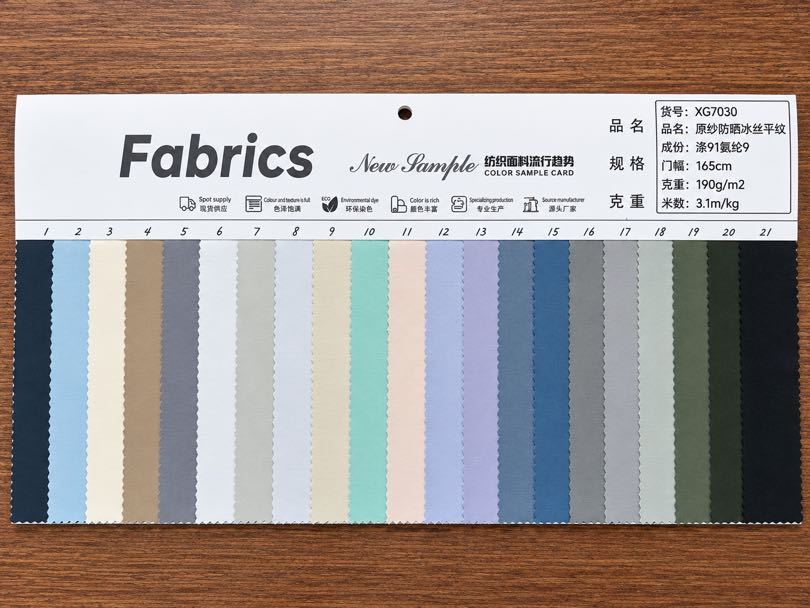
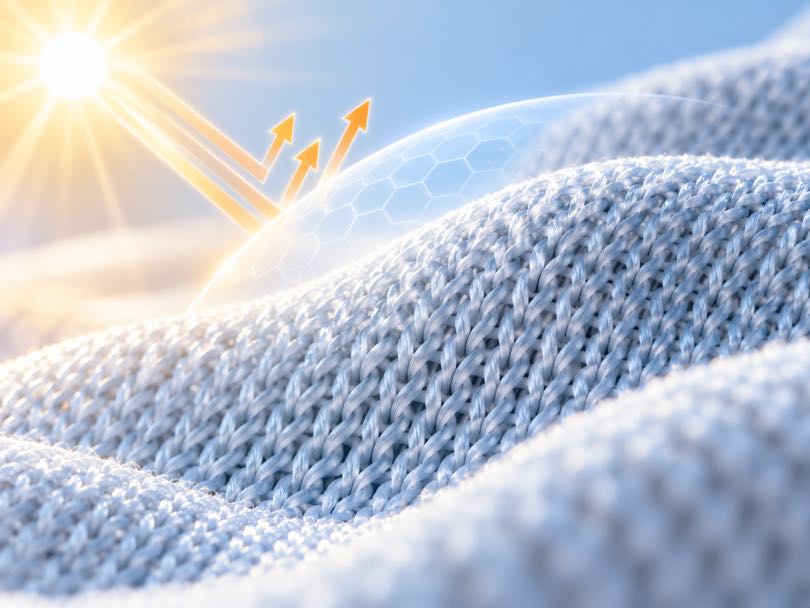
If you source fabric for sun-protective apparel, you have probably seen “UPF 50+” on almost every spec sheet. The harder question is where that protection comes from, and whether the fabric can still meet your other requirements.
In this guide, we explain how yarn-level UV protection fabric works and how it differs from finish-applied treatments. We also show what to look for in a test report, using results from accredited third-party labs on our own knit fabric. Let’s start with the basics.
What Is Yarn-Level UV Protection?
Yarn-level UV protection means the UV-blocking function is built into the yarn itself, rather than added to the finished fabric. UV-blocking particles, such as titanium dioxide or ceramic powders, are mixed into the polymer during spinning. They stay inside the fibers and help block UV rays by absorbing and scattering them.
Many other fabrics reach their UPF rating differently. They use a UV-absorbing finish applied during dyeing, plus a dense knit or weave. Both routes can pass a UPF test, but they behave differently in production and in use.
Yarn-Level vs. Finish-Applied UV Protection
Here is how the two approaches usually compare:
Yarn-level | Finish-applied | |
Where UV protection comes from | Inside the fiber | On the fiber surface |
Effect of fabric density | Lower, because the fiber itself blocks UV | Higher, because the gaps do much of the work |
Effect on dyeing | Needs careful control of the powder | Minimal |
When protection is added | Set at the yarn stage | Set at the finishing stage |
General cost | Higher | Lower |
Best suited for | Garments worn and washed often | Short-life or promotional items |
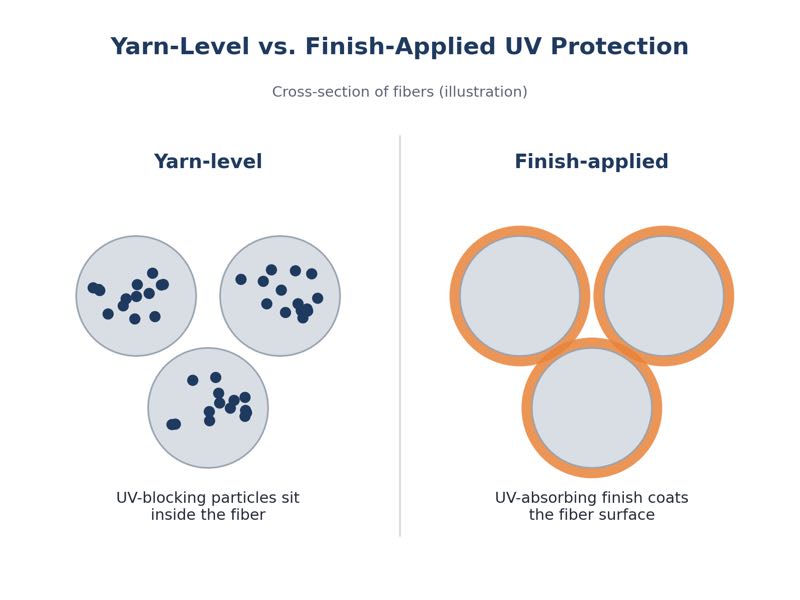
For sun-protective clothing fabrics such as fishing shirts, running tops and sun hoodies, yarn-level protection is worth considering. The UV-blocking material is part of the fiber, so protection does not rest on a surface treatment alone.
No single method guarantees results, though. Fabric structure, color and weight still affect UPF.
What Does UPF 50+ Actually Mean?
UPF stands for Ultraviolet Protection Factor. It tells you how much UV radiation a fabric lets through.
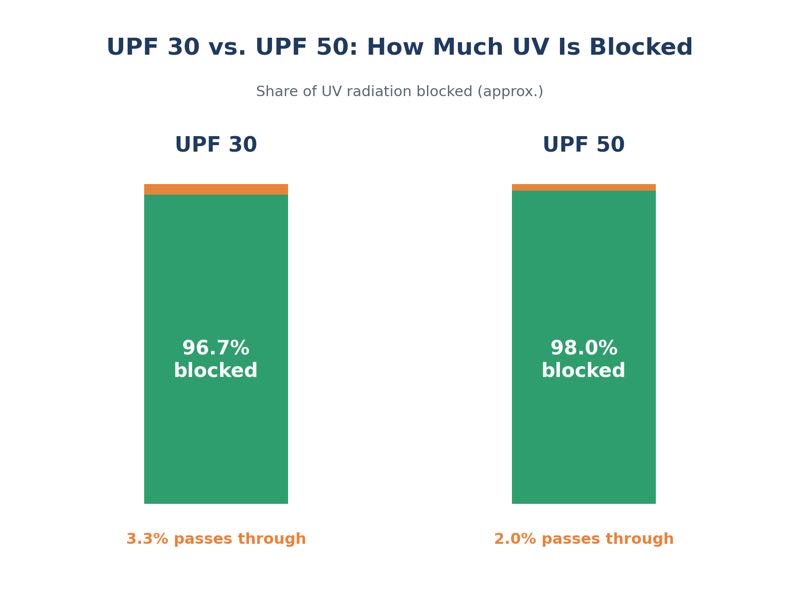
A UPF of 50 means about 1/50th, or roughly 2%, of UV reaches the skin. In other words, about 98% is blocked. UPF 30 blocks about 96.7%. The gap looks small on paper, but it adds up for garments worn for hours in strong sun.
“UPF 50+” is also not tested the same way everywhere. Hohenstein, a textile testing institute, lists several systems: UV Standard 801, EN 13758-1 in Europe, AS/NZS 4399 in Australia and New Zealand, and AATCC TM 183 in the United States. Testing conditions can vary between them.
In China, GB/T 18830-2009 is used to evaluate UV protection in textiles. A result under this standard should not automatically be treated as an AATCC TM 183 or AS/NZS 4399 result. When you compare reports, always check the standard and the test conditions.
What Our Third-Party Test Reports Show
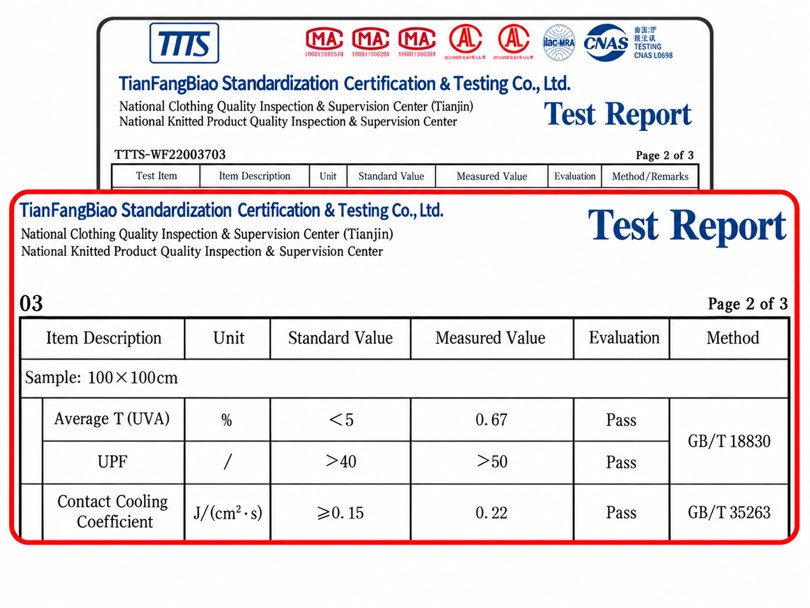
Third-party testing helps confirm the UV protection and cooling performance of functional fabrics. The following results come from a TTS test report for a submitted fabric sample.
UV Protection and Cooling Test Results
Test | Result | Standard Requirement | Test Method |
UVA Transmittance (Average) | 0.67% | <5% | GB/T 18830-2009 |
UPF | >50 | >40 | GB/T 18830-2009 |
Contact Cooling Coefficient | 0.22 J/(cm²·s) | ≥0.15 J/(cm²·s) | GB/T 35263-2017 |
What Do These Results Mean?
UVA transmittance of 0.67% means that only 0.67% of UVA radiation passes through the fabric. This is well below the standard’s 5% limit, showing that the fabric blocks more than 99% of UVA radiation under the test conditions.
A UPF above 50 means the fabric provides strong UV protection. The higher the UPF, the less UV radiation passes through the fabric. Under GB/T 18830-2009, a fabric must meet both UPF and UVA transmittance requirements to qualify as UV-protective. Results above 50 are labeled “UPF 50+”.
A contact cooling coefficient of 0.22 J/(cm²·s) is above the required minimum of 0.15 J/(cm²·s). A higher value indicates a stronger cooling feeling when the fabric first touches the skin. This result meets the stated test requirement.
What These Results Cover
The TTS report confirms the tested sample’s UV protection and contact cooling performance under the specified test conditions. However, it does not include UPF results after repeated washing or when the fabric is stretched. These are important factors when evaluating UV protection during actual use.
Why Yarn-Level UV Fabric Demands Tight Technical Control
Adding UV-blocking powder to yarn is not a simple step. It can affect spinning, dyeing and the finished fabric, so it has to be managed alongside other technical requirements.
- Powder dispersion. If particles clump, UV protection may vary across the fabric and spinning gets harder. Even distribution keeps performance consistent.
- Dyeing. Mineral content can change how dye takes up. Color depth also affects UV blocking, so shade and UPF must be managed together.
- Hand feel. More powder can make yarn stiffer. Careful process control keeps the fabric soft and smooth.
- Batch consistency. A good sample is not enough if bulk production varies. Yarn quality, heat-setting and fabric weight all need tight control.
Beyond UPF 50+: Cooling, Quick-Dry and Stretch
Sun-protective garments are rarely judged on UPF alone. Buyers also want a cooling fabric that feels fresh on the skin, a quick-dry fabric that dries quickly, and a 4-way stretch knit that moves with the body.
The Chuangbiao report includes results for several of them:
Property | Result | Method |
Contact cooling coefficient | 0.25 J/(cm²·s) | GB/T 35263-2017 |
Air permeability | 294 mm/s | GB/T 5453-1997 |
Moisture permeability | 11,590 g/(m²·24h) | GB/T 12704.1-2009 |
Drying rate | 0.35 g/h | GB/T 21655.1-2023 |
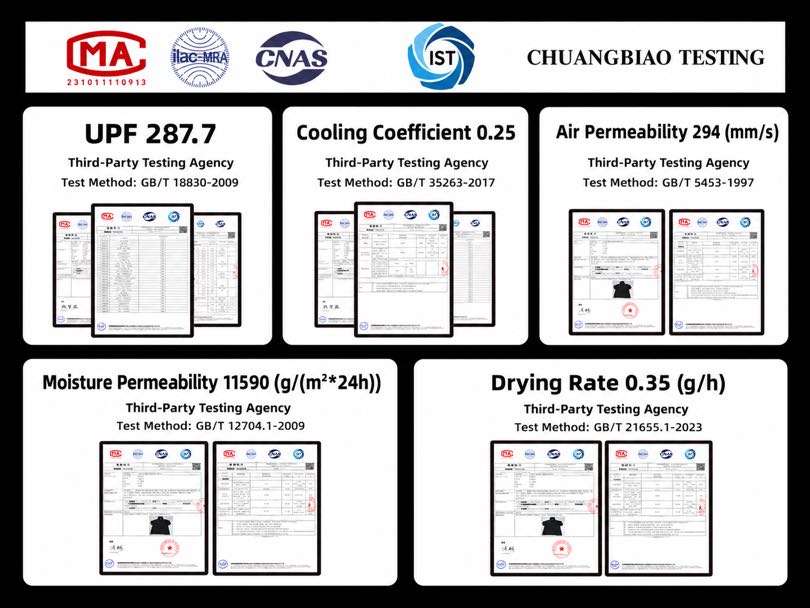
The Chuangbiao report provides additional performance data beyond UV protection. The tested fabric achieved a contact cooling coefficient of 0.25 J/(cm²·s), air permeability of 294 mm/s, moisture permeability of 11,590 g/(m²·24h), and a drying rate of 0.35 g/h.
These results indicate that the fabric combines UV protection with cooling touch, breathability, moisture transfer, and drying performance. They apply only to the tested sample under the stated test methods and do not show how UV protection changes after washing or stretching.
Why Stretch and Washing Matter When You Evaluate Any UPF Fabric
Whichever supplier you work with, two questions are worth asking.
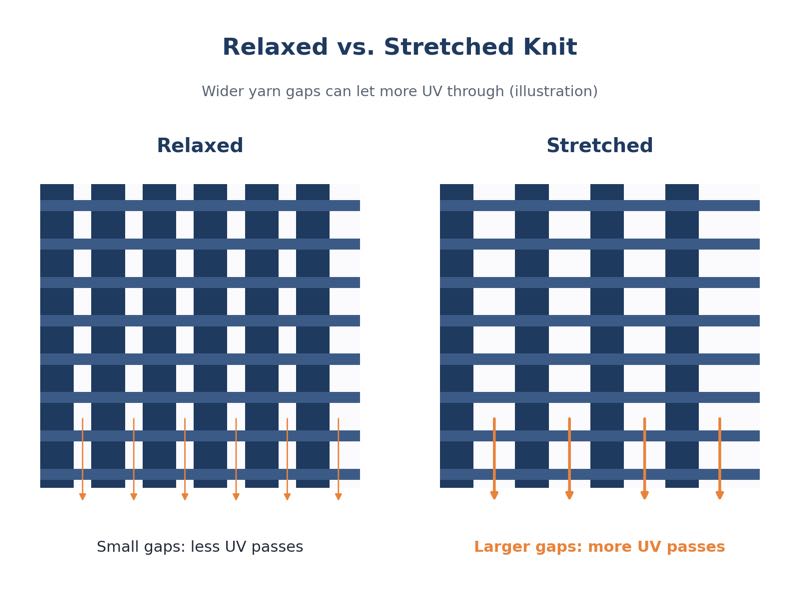
Does the fabric still protect when stretched? Hohenstein explains that stretching can affect UV protection. When fabric stretches, the gaps between yarns can widen and let more UV through. Fabrics with more stretch or lighter colors may be more affected.
Has the fabric been tested after washing? Claims of “permanent” UV protection should be supported by test results. A reliable claim should state the number of washes, washing method, and UPF test method. Without these details, it is difficult to confirm UV protection after washing.
Yarn-level protection is a good starting point because the UV-blocking material sits in the fiber. Final UPF still depends on fabric construction, garment design and how the garment is used.
What to Ask For Before You Approve a UV Protection Fabric
Use this checklist with any supplier:
- A UPF report from an accredited lab, with the standard named
- The standard your market recognizes (AATCC TM 183, AS/NZS 4399, EN 13758-1 or others)
- Reports for each color you plan to sell, since light colors are usually the hardest case
- Washing data, with the number of washes stated
- Stretched-state data, if the fabric is a stretch fabric
- Separate reports for any extra claim, such as cooling or quick-dry, each with its own method
- How bulk consistency is controlled, from yarn spinning to heat-setting
If you sell in Europe, also check the requirements for UV-protective clothing under EU PPE Regulation 2016/425. Hohenstein covers this on its page as well.
A good supplier will answer these questions plainly, including the ones where the answer is “not tested yet.”
FAQ
What is yarn-level UV protection?
UV-blocking particles are added to the fiber during spinning. The protection is part of the yarn, not only a surface finish.
Is yarn-level protection better than a finish?
It depends on the application. Yarn-level protection does not rely only on a surface treatment, while finish-applied protection can also provide effective UV blocking. Durability depends on fabric construction, finishing quality, and washing conditions.
What does UPF 50+ mean?
It means the fabric blocks about 98% or more of UV radiation. Under GB/T 18830-2009, a fabric qualifies as UV-protective with UPF above 40 and average UVA transmittance below 5%. A UPF above 50 can be labeled “UPF 50+.”
Does UV protection decrease when fabric stretches?
It can, because stretching widens the gaps between yarns. Stretch fabrics should be tested under conditions that reflect their intended use.
Does yarn-level UV protection last after washing?
The UV-blocking material sits inside the fiber, so it does not depend only on a surface finish. Washing can still change fabric structure, so UPF testing after a stated number of washes is needed to confirm durability.
Next Step
When you compare UV protection fabrics, use the checklist above and ask each supplier for third-party test reports. Check the standard, the fabric color and the test conditions behind every number.
About Us
At Idear Textile, we supply functional fabrics for sun-protective clothing, fishing wear and outdoor apparel. We offer yarn-level UV protection fabrics with customizable specifications, supported by third-party test reports.
Looking for the right UV protection fabric for your next project? Request fabric samples or contact us to discuss your requirements.